Pocket Microscope Guide: Types, Magnification, Uses and How to Choose (2026)
What Is a Pocket Microscope?
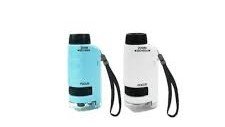
A pocket microscope is a small, portable magnifier, typically 20x to 120x, with a built-in LED light. It lets you inspect coins, plants, fabric, print and electronics on the spot, without a lab or a desk setup.
You will also see it called a handheld, mini, pen or field microscope. The names overlap, and the core idea is the same: a short optical tube that you rest on the object, light up and focus by hand.
Some models go beyond 120x, and you will see ranges up to 200x or 250x on some listings. The reason is covered in the magnification section below.
Why People Carry One
The appeal is immediacy. A pocket microscope takes seconds to use, costs far less than a bench instrument, and goes where the sample is.
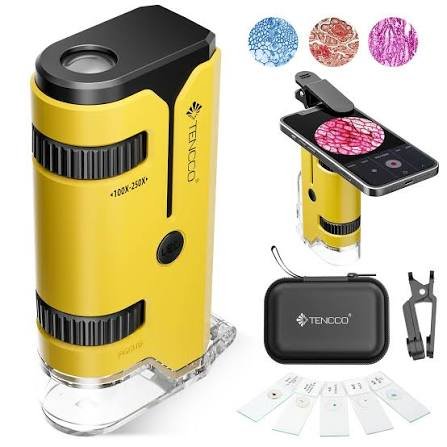
Researchers have long pointed to this convenience. A paper in the Journal of the Royal Microscopical Society describes the value of being able to magnify fine details, down to tens of micrometres, of almost any object on the spot. It also discusses how smartphones are becoming a new platform for pocket microscopy.
Who It Is For
- Collectors: coins, stamps, banknotes and minerals
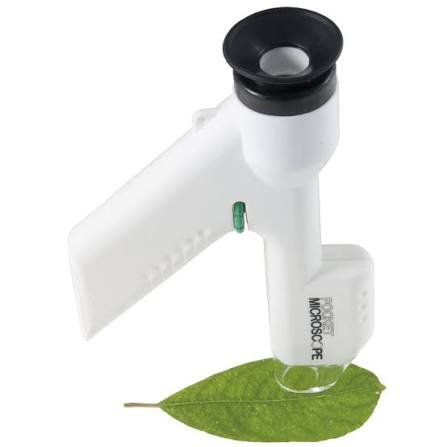
- Naturalists and gardeners: insects, leaf surfaces, seeds, soil
- Students, parents and teachers: low-cost STEM exploration
- Electronics technicians: solder joints, traces, component markings
- Print, textile and jewelry professionals: dot patterns, weave, surface finish
- Quality control, machining and forensics teams: quick checks, sometimes with a measuring reticle
How a Pocket Microscope Works
Inside the tube, an objective lens collects light from the sample and forms a magnified image. An eyepiece magnifies it again for your eye. A small LED lights the subject, and a focus wheel or sliding barrel changes the distance until the image is sharp.
In optical models, total magnification is the objective power multiplied by the eyepiece power. It is a simpler cousin of the compound microscope.
Better models use an aspheric lens to reduce edge distortion. Many are monocular, meaning one eyepiece, which keeps them light and compact.
Types of Pocket Microscopes
| Type | Typical range | Best for | Watch out for |
| Fixed optical | 20x to 60x | Coins, plants, kids | No zoom flexibility |
| Zoom optical | 60x to 120x | Hobbyists, inspection | Harder to hold steady |
| Pen or clip style | Several fixed options | Shirt-pocket carry, quick checks | Narrow field of view |
| UV-equipped | 20x to 60x plus UV | Banknotes, minerals | Eye safety |
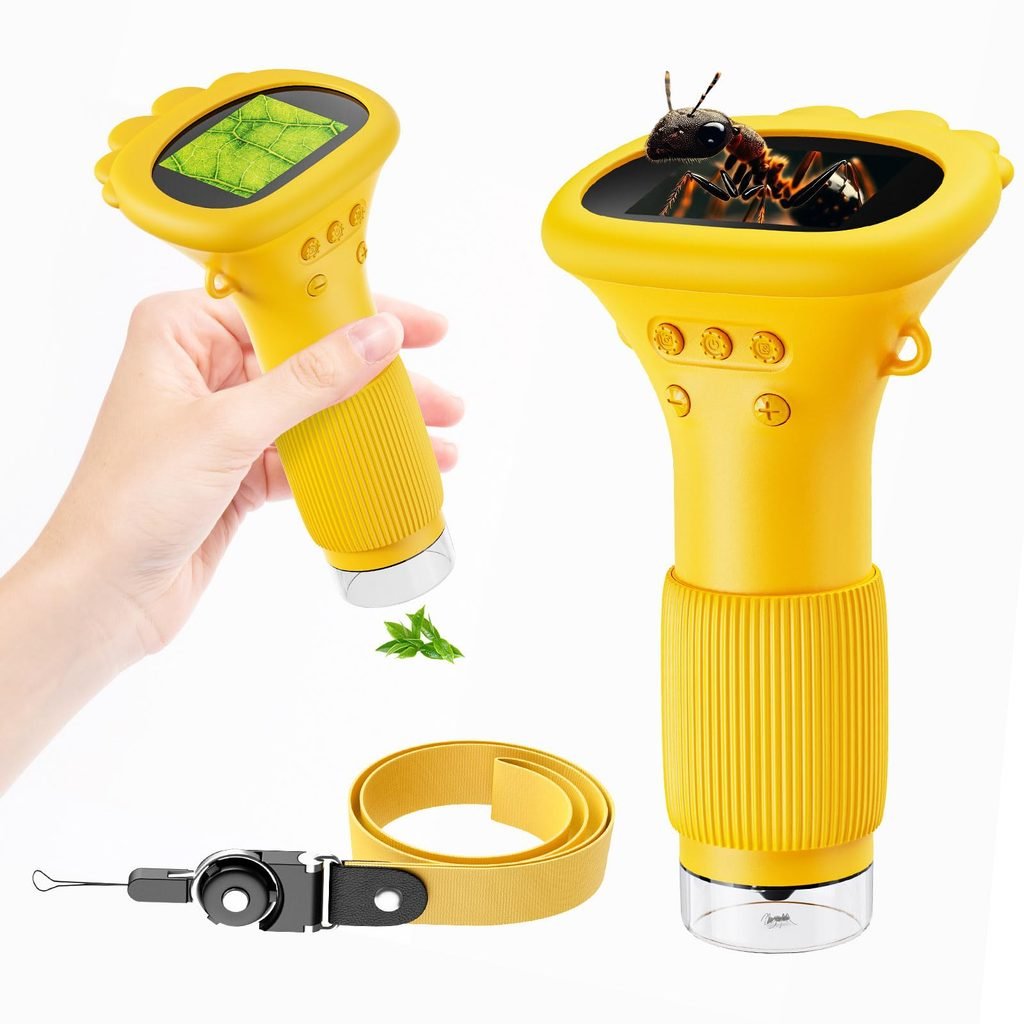
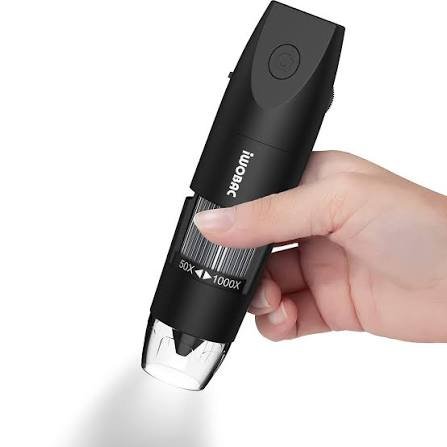
| Digital (USB or Wi-Fi) | Varies | Photos, sharing, screen viewing | Inflated “digital zoom” claims |
| Smartphone clip-on | Varies with phone | Casual use, documentation | Alignment and image quality |
Magnification: Choose by Task, Not by Number
Higher power is not automatically better. As magnification rises, the field of view narrows, depth of field shrinks, and the image becomes harder to hold steady.
| Magnification | What it usually shows well |
| 10x to 30x | Coin details, stamps, fabric weave |
| 30x to 60x | Insect structure, leaf surface, circuit traces |
| 60x to 120x | Fine fibers, printed dot patterns, small crystals |
Why listings disagree. Pages quote different ranges, from 20x to 120x up to 250x, because they count different products. A reasonable rule is that most pocket microscopes sit between about 20x and 120x, and anything higher deserves a closer look at how the number is defined.
Optical vs digital magnification. Optical magnification comes from lenses and adds real detail. Digital zoom enlarges pixels, so the image gets bigger but not sharper. A “1000x” figure on a handheld digital device usually reflects screen size and software zoom rather than true optical resolution.
What a Pocket Microscope Can and Cannot See
It handles surfaces well: mint marks, leaf hairs, insect legs, paper fibers, solder cracks, halftone dots.
It is not the right tool for bacteria, blood cells or prepared slides. Those need a compound light microscope with higher-power objectives, transmitted light and a stage. If your goal is cell-level detail, plan to move up.
Lighting and Steadiness: What Most Guides Skip
Most blurry results come from poor lighting or a moving hand, not a bad lens.
- Turn on the LED and check for glare. On shiny surfaces such as coins or metal, tilt the instrument slightly or add diffused light from a window or lamp.
- Rest your elbows on a table. Support your wrist against the surface.
- Touch the tip to a flat sample where the design allows it, to fix the distance.
- Focus slowly in small steps. Overshooting and returning is normal.
- Start low, then increase. Find the feature at low power, then zoom in.
At 100x and above, a small stand or a bean-bag rest makes a visible difference.
Uses by Hobby and Profession
Coins and stamps. Around 30x to 60x is usually enough to see wear, mint marks and printing details.
Plants and insects. Pocket models make it easy to check the underside of a leaf for pests while still in the garden.
Electronics. Technicians inspect solder joints and board traces, often with a stronger LED and a steady rest.
Printing, textile and jewelry. Dot patterns, weave quality and surface finish are common checks.
Industrial and forensic work. Some models include measuring reticles, which let you estimate feature size against a scale.
Banknote checks. Models with a UV LED can reveal fluorescent security features on some documents.
Pocket Microscope vs Alternatives
| Tool | Best at | Main trade-off |
| Magnifying glass | Reading, general viewing | Low power |
| Loupe (about 10x to 30x) | Quick jewelry and print checks | Limited detail |
| Pocket microscope | Portable, higher-power surface inspection | Moderate optical quality, needs steadiness |
| USB digital microscope with stand | Desk inspection and recording | Not truly pocketable |
| Stereo microscope | 3D viewing of larger samples | Bulky and costly |
| Compound microscope | Slides, cells, microorganisms | Not portable, needs preparation |
If a loupe already shows the detail you need, you probably do not need a pocket microscope. If you need to record or share images, a digital model or a phone clip-on may serve you better.
How to Choose: A Simple Decision Framework
Step 1: What will you examine? Coins and stamps suggest 20x to 60x. Plants and insects suggest 30x to 60x. Electronics and print suggest 60x to 120x.
Step 2: Who will use it? Children need a sturdy body, simple focus and low power. Professionals need consistent optics and durability.
Step 3: Where will you use it? Outdoors, favor compact size and a protective cap. At a desk, a digital model with a stand may be easier.
Step 4: Check the features.
- Built-in LED, and UV if you need it
- Glass or aspheric lens, rather than a basic plastic one
- A smooth, firm focus mechanism
- Battery type that is easy to find locally
- Case, cap or clip
- A clear return policy
Step 5: Match your budget to a tier.
| Tier | What to expect |
| Entry level | Fixed 20x to 60x, simple LED, plastic body |
| Mid range | Better lens, zoom, stronger LED, sturdier build |
| Professional or digital | Higher build quality, reticles, camera sensors, accessories |
Prices vary widely by country, brand and retailer, so compare current listings and include shipping and import duties in your total.
Brands and Models You Will Meet
Product names that show up repeatedly in the category include the Carson MicroBrite Plus (60x to 120x zoom), the Carson MicroMini (20x, with UV and a keychain attachment), the SE Mini lighted pocket microscope, the SVBONY SV603, Apexel smartphone microscopes and the PEAK pen-style pocket microscopes. Treat these as examples to compare, not endorsements.
Safety and Common Mistakes
Safety
- Never look at the sun through any optical device.
- Avoid looking directly into UV LEDs.
- Keep button-cell batteries away from young children and supervise their use.
- A pocket microscope is not a medical diagnostic tool.
- Imported digital or battery-powered models may need to carry conformity marks such as CE or UKCA, depending on your region.
Common mistakes
- Buying the highest zoom without checking lens quality
- Trusting “digital magnification” figures
- Pressing the lens hard onto the sample
- Ignoring lighting
- Expecting slide-level detail from a surface tool
- Skipping the return policy
Care and Maintenance
- Keep the cap on when not in use.
- Remove dust with a blower first, then use a lens cloth.
- Avoid touching the lens with fingers.
- Take out batteries for long storage.
- Store somewhere dry, away from humidity.
- Do not use harsh solvents on plastic parts.
Buying Around the World
Online marketplaces, educational suppliers, optical and jewelry suppliers, electronics wholesalers and hobby shops all sell pocket microscopes. Availability and prices differ by country, and import duties and shipping can change the final cost. Battery formats also vary by region, so check that the model uses a battery you can easily replace.
Searching for a science supply or hobby shop nearby is useful if you want to test the focus feel before buying.
Practical User Experience
This section describes what to expect in practice, based on how these tools behave, rather than a claim of personal ownership of a specific model.
The first thing most people notice is how small the usable area is. At 60x or higher, you see a tiny patch of the object, and small hand movements shift the image noticeably. It takes a few minutes to learn to anchor your hand and move slowly.
Lighting makes the biggest difference. On shiny coins or metal, the built-in LED can create glare, and tilting the instrument slightly usually improves the view more than changing magnification.
Lower power is often more satisfying than expected. At 30x to 40x the image is brighter, easier to hold and wider, which suits most collecting and garden checks.
Zoom models are flexible but need patience, and cheap plastic optics can show soft edges. For kids, a simple fixed-power model tends to cause less frustration than a zoom one.
Overall impression: a pocket microscope is a practical, low-effort inspection tool with clear limits. It rewards a bit of technique, and it is best chosen for a specific task rather than for the biggest number on the box.
Frequently Asked Questions
1.What is a pocket microscope used for?
It is used to magnify small objects such as coins, plants, insects, fabric, print and electronic components, in the field or at a workbench.
2.How powerful is a pocket microscope?
Most range from about 20x to 120x. Some listings go higher, but very high numbers often reflect digital zoom rather than added optical detail.
3.What is the best magnification for a pocket microscope?
For most users, 30x to 60x balances detail, brightness and ease of use. Choose 60x to 120x for fine fibers, print or electronics, and expect a steadier hand to be necessary.
4.Can a pocket microscope see bacteria or cells?
Generally no. Cells and bacteria require a compound light microscope with prepared slides and higher-power objectives.
5.Are pocket microscopes good for kids?
Yes, with supervision. Choose a sturdy model with simple focus and moderate power, and manage battery safety carefully.
6.Pocket microscope vs magnifying glass: which is better?
A magnifying glass is better for reading and wide views. A pocket microscope gives much higher power over a small spot, with built-in light.
7.Do pocket microscopes need batteries?
Many do, for the LED or UV light. Some simple optical models work with ambient light only.
8.Is digital magnification real? Digital zoom enlarges pixels and does not add real detail. Optical magnification comes from lenses and is the figure that matters for sharpness.
9.How do I stop the image from shaking?
Rest your elbows on a table, anchor your hand against the surface, focus slowly, and start at low power. A small stand helps at higher zoom.
10.Can a pocket microscope check banknotes?
Models with a UV LED can show fluorescent features on some banknotes and documents. Results vary by currency, so use it as a supporting check.
Conclusion
A pocket microscope is a practical way to see surface detail wherever you are. It does not replace a laboratory instrument, but for collecting, gardening, inspection and early STEM learning, it fits well.
To choose well:
- Decide what you will examine most often.
- Start with 30x to 60x unless you have a clear need for more.
- Check light, lens quality and focus feel.
- Compare tiers, shipping and return policies.
- Practice on flat samples, then move to trickier ones.
- Step up to a compound microscope if you need cell-level detail.
Unfulfilled Points: Parts diagram, size-in-hand photo and comparison images could not be produced in text. Local “near me” content is kept short because the scope is Global.
These information are gathered from different surveys, medical tests and tech giants like Techradar and more. Our top priority is to provide you valuable information about Pocket Microscope.
For More Details About Different Digital Microscopes Click Here